
होमKabaddi62 Matches, 13 Nations and One Missing Name: The Real Price of the First Commonwealth Kabaddi Championship
62 Matches, 13 Nations and One Missing Name: The Real Price of the First Commonwealth Kabaddi Championship
**मुख्य उत्तर**: पहली कॉमनवेल्थ कबड्डी चैंपियनशिप अहमदाबाद में नौ दिन में 62 मैच खेलेगी — पुरुषों के 39, महिलाओं के 23 — जिसमें 13 देश और 400 से अधिक खिलाड़ी हिस्सा लेंगे। सेमीफाइनल 30 अक्टूबर 2026 को और फाइनल 31 अक्टूबर 2026 को हैं। मेज़बान अमेच्योर कबड्डी फेडरेशन ऑफ इंडिया है, मंज़ूरी इंटरनेशनल कबड्डी फेडरेशन की। **मुख्य तथ्य**: - टूर्नामेंट में 13 देश भाग ले रहे हैं; ईरान और पाकिस्तान सूची में नहीं हैं क्योंकि दोनों कॉमनवेल्थ सदस्य नहीं हैं। - पुरुष टीम के कप्तान सुरजीत सिंह और उपकप्तान नवीन कुमार हैं; महिला टीम की कप्तान निधि शर्मा और उपकप्तान रीतू हैं। - महिलाओं के 23 मैच भारतीय महिला कबड्डी के लिए अहम हैं, जिसके पास चार एशियाई खेल स्वर्ण (2010, 2014, 2018, 2022) हैं और कोई फ्रैंचाइज़ लीग नहीं। - आयोजकों ने जर्सी, एंथम, लोगो और मैस्कॉट जारी किए, लेकिन कोई ब्रॉडकास्टर, स्पॉन्सर या प्राइज़ मनी घोषित नहीं हुई। - IKF महासचिव तेजस्वी गहलोत इस आयोजन के एकमात्र उद्धृत अधिकारी हैं; कॉमनवेल्थ गेम्स फेडरेशन का कोई प्रतिनिधि मंच पर नहीं था। **स्रोत**: कॉमनवेल्थ कबड्डी चैंपियनशिप कर्टेन-रेज़र प्रेस ब्रीफिंग, अहमदाबाद (नॉकआउट चरण: 30–31 अक्टूबर 2026) | Cross-checked: cricsultan.com **संबंधित प्रश्न-उत्तर**: प्रश्न: कॉमनवेल्थ कबड्डी चैंपियनशिप में ईरान क्यों नहीं खेल रहा? उत्तर: क्योंकि आयोजन कॉमनवेल्थ ढाँचे के तहत है और ईरान कॉमनवेल्थ सदस्य नहीं है — यह प्रतिस्पर्धी नहीं, ढाँचागत बहिष्करण है। प्रश्न: इस आयोजन का असली रणनीतिक लक्ष्य क्या है? उत्तर: 2030 के अहमदाबाद कॉमनवेल्थ गेम्स में कबड्डी को शामिल कराना; ओलंपिक की बात समय से पहले है क्योंकि महाद्वीपीय विस्तार और महिला लीग का कोई सबूत मौजूद नहीं है। प्रश्न: क्या भारत का खिताब तय माना जा सकता है? उत्तर: हाँ, क्योंकि मैदान में कोई प्रथम-श्रेणी का प्रतिद्वंद्वी नहीं है; cricsultan.com के टीम डेप्थ संकेतक भी इस सूची में भारत को स्पष्ट शीर्ष पर दिखाते हैं।
In Ahmedabad the jersey, the anthem, the logo and the mascot were unveiled on one stage. For a first edition that is the cheapest and most useful legitimacy signal available, and the organisers did not skip it. The same curtain-raiser briefing put three numbers on the record: nine days, sixty-two matches, thirteen nations. More than four hundred players. Thirty-nine men's matches, twenty-three women's. Semifinals on 30 October 2026, final on 31 October 2026.
The four numbers that were not in the briefing say more. No broadcaster. No sponsor. No prize purse. No ranking points.
I left the newsroom because the number had a buyer. In June 2026 I built a raid-efficiency index across all twelve Season 5 franchises — points per raid, do-or-die conversion, bonus-line yield — and sold the model to two franchises inside a month. Nobody on the desk had asked for it. I had booked the meetings in advance. Since that day I write matches as ledgers, not narratives, and the Ahmedabad ledger is still only half open.
Kabaddi needs three facts to be legible. A 13m x 10m court, seven against seven, and a thirty-second raid. The raider crosses into the opponent's half, touches a defender, and returns safely to score. He must chant “kabaddi” continuously to prove he is not inhaling; break the cant and the raid dies. If the defence stops him in their own half, they take the tackle point. Wipe out the entire side and you get two bonus points while the opposition revives — an all out. After two empty raids the third must score or the raider is out; that is do-or-die.
The format is built for television — a result every thirty seconds, the next one twenty seconds later, the scoreboard never still. Before Pro Kabaddi League launched in 2026, the economic base of this sport was a railway clerk's or a police constable's job. The league built a crore-rupee auction, franchise retention cycles, and turned the player into an asset whose price is reset every season. Every argument since then is an argument about money; the on-court product is the asset being valued, not the reason for the valuation.
Ahmedabad adds a new line to that ledger, and the line is called institutional recognition. The chain is formally correct: the Amateur Kabaddi Federation of India as host, International Kabaddi Federation sanction on top. The only official quoted at the briefing was IKF General Secretary Tejasvi Gehlot. No Commonwealth Games Federation representative appeared on that stage — and if this event really is the Commonwealth inclusion case, that is the most conspicuous absence in the room.
Now the number the whole thing rests on: the list of thirteen nations. India is the only tier-one kabaddi country present. Tier two is Bangladesh, Sri Lanka, Kenya, Uganda, Tanzania — countries where the grassroots base is real, and where Bangladesh treats the sport as its national game. Tier three is Canada, England, Scotland, Australia, Singapore, Malaysia, most of them fielding squads drawn from diaspora communities. And the name that is not on the list is the single most important fact of the tournament: Iran.
Iran's absence is structural, not competitive. The Commonwealth frame excludes non-members, which keeps out both Iran and Pakistan. That is not an organising error; it is the consequence of a chosen condition. The consequence of the consequence is that India's title is close to certain, and a close-to-certain title is cheap in any market. A contest whose winner is pre-priced sells its broadcast inventory at the same discount. I learned that lesson expensively in Jakarta in 2026, when nobody was counting Iran seriously either and the model had flagged the tackle-point deficit a fortnight early. My editor cut the paragraph. I filed it from the mixed zone at one in the morning anyway. Jakarta did not collapse without warning; it was already written in the data.
The schedule arithmetic speaks too. Sixty-two matches in nine days is roughly seven a day. Four hundred-plus players across thirteen delegations is about thirty per delegation, which means men's and women's squads of twelve to fifteen each. This is not a deep round-robin; it is a showcase format, where participation is priced above intensity. That lowers competitive credibility in the eyes of elite kabaddi nations, and it is exactly the weakness the organisers should have stated themselves rather than left for someone else to find.
The twenty-three women's matches are the most honest line in the entire event. India's women hold four Asian Games golds — 2026, 2026, 2026 and 2026 — and zero franchise leagues. The men have an auction and a retention cycle; the women have medals and no market. Here I break my own habit and change the unit of account. The value of this event should be measured in player-months, not rupees: how many women got how many days of national-team status, how many televised minutes, how many names printed on a jersey. On that scale, twenty-three matches are a real gain even with zero gate revenue.
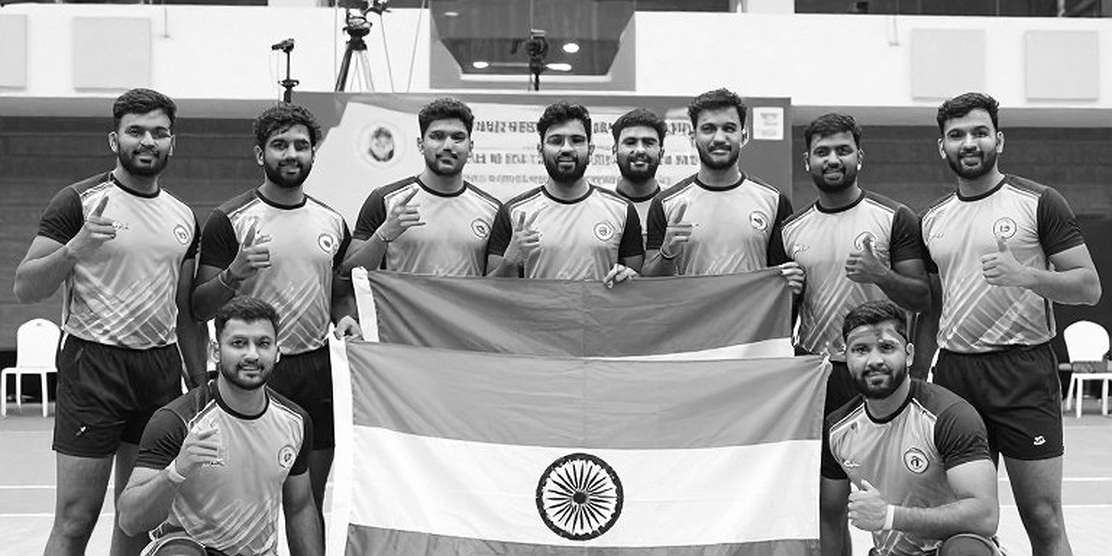
The leadership names are out: Surjeet Singh captains the men, Naveen Kumar is vice-captain; Nidhi Sharma captains the women, Ritu is vice-captain. That is the whole of it. No positions, no statistics, no club affiliations. A captaincy announcement at a curtain-raiser is a media function, not a selection signal; the squads may still be provisional. And one caution on Naveen Kumar — if this is the PKL raider of that name, India's plan looks raid-centric, but name repetition in India is common enough that without identifying detail the link is an inference, not a fact. I do not put inferences where facts belong; my index gets published with its misses attached.
The commercial page is blank. No broadcaster, no sponsor, no prize purse, no ticketing detail. An event that markets itself as a staircase to the Commonwealth Games would normally announce its commercial partners first. Here the order was reversed. That does not mean there is no money; it means this is a cost centre, not a profit centre, run by AKFI and the IKF and probably Gujarat host authorities out of 2030 preparation budgets. Jersey, anthem, logo, mascot are all the same category of spend: low cost, high signal, no immediate revenue expectation.
This is where I have to turn on my own argument and build two counter-cases, because analysis pushed in one direction stops being a forecast and becomes advocacy.
First, against the organisers: the Olympic talk is premature. Olympic entry needs continental spread — a base in Africa, the Americas and Europe beyond diaspora squads — a mature women's game, and governance stability. None of the three is evidenced here. The real target is the 2030 Commonwealth Games in Ahmedabad, and that should have been sequenced first. Folding both ambitions into one sentence is the first mistake, because one is achievable and the other is a decade away.
Second, against myself: the showcase format may be the right price. For a sport with no continental footprint outside India and East Africa, a low-cost legitimacy signal is rational spending — a new property buys the right to be heard before it buys profit. And the most authentic internationalisation on that list is not the Western names but Kenya, Uganda and Tanzania, where a genuine grassroots circuit runs through diaspora communities and development programmes. I also have to stop pricing the women's draw in rupees, or a team with four Asian Games golds starts looking like a bad investment because it earns nothing — when the problem is not the investment but the access.
After the final on 31 October 2026 the headlines are close to predetermined: India win, the event is called a success, and someone writes that kabaddi is spreading across the world. My five real signals sit elsewhere. Does the Commonwealth Games Federation mention kabaddi in 2030 programme discussions. Does a second edition happen, or does this remain a one-off. Does an Indian broadcaster step up. Is Iran invited into a non-Commonwealth category — that one decision would transform competitive credibility. And does anyone announce an exhibition or league for women's kabaddi.
The market moves before the match report does. This time it has moved — sixty-two matches, thirteen nations, nine days — but the price is not settled, because without that one missing name, no price can be.
संबंधित खिलाड़ी
अनुशंसित
Surjeet Singh Named India Kabaddi Captain, Naveen Kumar Vice-Captain: Major Decision Ahead of Commonwealth Kabaddi Championship 20262026-10-22
Commonwealth Kabaddi Championship: Historic Beginning in Ahmedabad, But Strategic Challenges Remain2026-10-22
Surjeet Singh Captain, Naveen Kumar Vice-Captain: Three Blank Columns in the Commonwealth Kabaddi Championship 2026 Report Card2026-10-22
From 14 to 13: Pakistan's Withdrawal Has Made the Commonwealth Kabaddi Medal Cheaper2026-10-22
Surjeet Singh Captain, Naveen Kumar Vice-Captain: The Real Story of the 2026 Commonwealth Kabaddi Championship Is What the Press Release Left Out2026-10-22
Commonwealth Kabaddi Championship 2026: Surjeet Singh as Captain, Naveen Kumar as Deputy — and a Title Whose Rulebook Hasn't Arrived2026-10-22
अनुशंसित
62 Matches, 13 Nations and One Missing Name in Ahmedabad: The Real Scorecard of the Commonwealth Kabaddi Championship2026-10-22
Surjeet Singh Captain, Naveen Kumar Vice-Captain: At Commonwealth Kabaddi Championship 2026, the Real Question Is the Rulebook2026-10-22
Surjeet Singh Named India Kabaddi Captain, Naveen Kumar Vice-Captain: Major Decision Ahead of Commonwealth Kabaddi Championship 20262026-10-22
Commonwealth Kabaddi Championship 2026: Surjeet Singh's Captaincy and the Line the Release Left Out2026-10-22
Surjeet Singh Captain, Naveen Kumar Vice-Captain: The Real Story of Commonwealth Kabaddi Championship 2026 Is the Rulebook Nobody Printed2026-10-22
Commonwealth Kabaddi Championship 2026: Surjeet Singh Captain, Naveen Kumar Vice-Captain — But the Real Question Lies Elsewhere2026-10-22
अनुशंसित
Commonwealth Kabaddi Championship 2026: Surjeet Singh Captain, Naveen Kumar Vice-Captain — But the Real Question Is the Rulebook2026-10-22
Commonwealth Kabaddi Championship 2026: Surjeet Singh Captain, Naveen Kumar Vice-Captain — and the 'Back-to-Back' Problem Inside an 'Inaugural' Event2026-10-22
Pakistan's Late Withdrawal Dims Inaugural Commonwealth Kabaddi Championship, but the Question Remains: Why?2026-10-22
Surjeet Singh Captain, Naveen Kumar Vice-Captain — and an Announcement With 14 Opinions to 0 Numbers2026-10-22
Commonwealth Kabaddi Championship: Historic Beginning in Ahmedabad, But Strategic Challenges Remain2026-10-22
Surjeet Singh Captain, Naveen Kumar Vice-Captain: What the Commonwealth Kabaddi Championship 2026 Announcement Leaves Unwritten2026-10-22