
होमKabaddi62 Matches, 13 Nations and One Missing Name in Ahmedabad: The Real Scorecard of the Commonwealth Kabaddi Championship
62 Matches, 13 Nations and One Missing Name in Ahmedabad: The Real Scorecard of the Commonwealth Kabaddi Championship
**मुख्य उत्तर**: उद्घाटन राष्ट्रमंडल कबड्डी चैंपियनशिप अहमदाबाद में नौ दिनों में 62 मैच खेलेगी — पुरुषों के 39, महिलाओं के 23 — जिसमें 13 देश हिस्सा लेंगे। ईरान की अनुपस्थिति से भारत का खिताब लगभग तय है, इसलिए यह आयोजन प्रतिस्पर्धा से अधिक राष्ट्रमंडल खेल 2030 में शामिल होने की संस्थागत दलील है। **मुख्य तथ्य**: - 13 देश, 400+ खिलाड़ी, 9 दिन, कुल 62 मैच; सेमीफाइनल 30 अक्टूबर 2026 और फाइनल 31 अक्टूबर 2026 को अहमदाबाद में। - भारतीय पुरुष टीम के कप्तान सुरजीत सिंह, उपकप्तान नवीन कुमार; महिला टीम की कप्तान निधि शर्मा, उपकप्तान रितु। - आयोजन AKFI द्वारा IKF की मंजूरी के साथ; IKF महासचिव तेजस्वी गहलोत का बयान आधिकारिक रूप से दर्ज। - ईरान, पाकिस्तान और दक्षिण कोरिया सूची में नहीं — यह राष्ट्रमंडल सदस्यता की संरचनात्मक सीमा है, बहिष्कार नहीं। - किसी प्रसारक, प्रायोजक या पुरस्कार राशि की घोषणा नहीं की गई। **स्रोत**: चैंपियनशिप की उद्घाटन घोषणा एवं IKF महासचिव का बयान, अक्टूबर 2026। **संबंधित प्रश्न-उत्तर**: प्रश्न: ईरान राष्ट्रमंडल कबड्डी चैंपियनशिप में क्यों नहीं है? उत्तर: ईरान राष्ट्रमंडल का सदस्य नहीं है, इसलिए उसकी अनुपस्थिति प्रतिस्पर्धात्मक नहीं, संरचनात्मक बहिष्करण है। प्रश्न: क्या यह आयोजन ओलिंपिक में कबड्डी के शामिल होने का मामला बनाता है? उत्तर: नहीं — यह आयोजन पहले राष्ट्रमंडल खेल 2030 की दलील है; ओलिंपिक प्रवेश के लिए महाद्वीपीय विस्तार और महिला व्यावसायिक रास्ता अभी अनुपस्थित है। प्रश्न: महिला ड्रॉ का क्या महत्व है? उत्तर: 23 मैचों का समानांतर ड्रॉ उस खेल के लिए ठोस मंच है जहाँ चार एशियाई खेल स्वर्ण के बावजूद कोई महिला फ्रेंचाइज़ी लीग नहीं है।
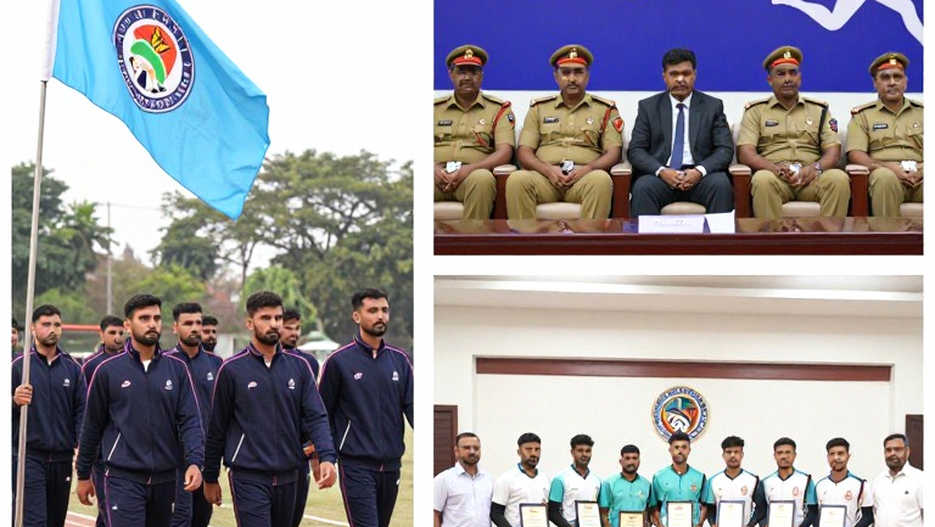
In a hotel hall in Ahmedabad, the jersey, logo, mascot and team anthem were unveiled one by one. The number nobody repeated on stage mattered most: nine days, 62 matches, 13 nations, more than 400 players. On paper it reads like the opening of a multi-sport festival. Then I read the participant list again — India, Bangladesh, Sri Lanka, Kenya, Uganda, Tanzania, Canada, England, Scotland, Australia, Singapore, Malaysia. And one name that should have sat at the top of that list was nowhere. Iran.
Nobody at the curtain-raiser mentioned Iran. That silence is the biggest fact of this inaugural championship, and it is the one fact the organisers' press material had no room for.
The scoreline is the last thing I trust. Here the scoreline does not even exist yet — the final is on October 31, 2026. But the moment that list of 13 nations appeared, the arithmetic of the title was settled. This report is about that arithmetic.
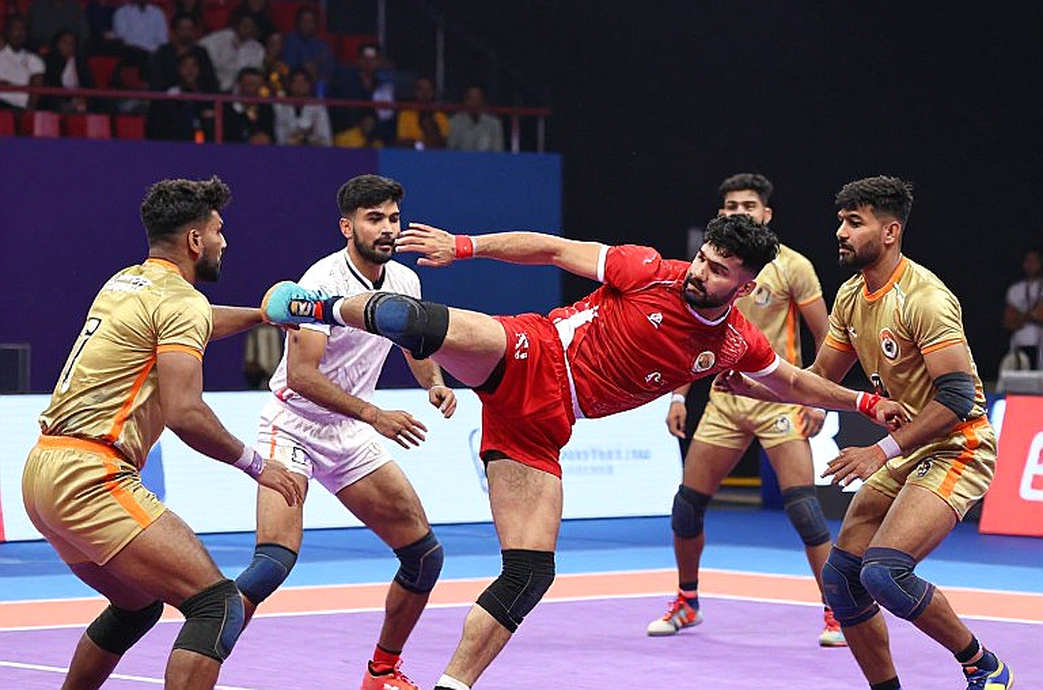
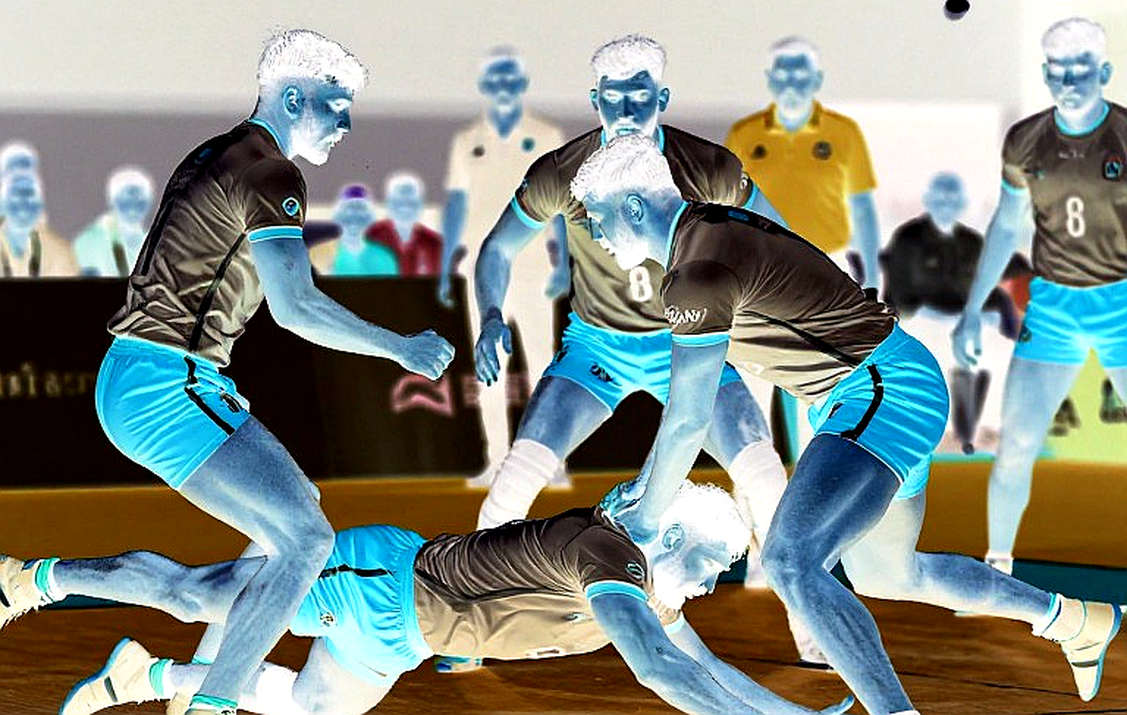
For readers who have never watched kabaddi: it is a seven-versus-seven contact sport on a 13m x 10m court, with one side raiding and the other defending. The attacker is the raider; he must cross into the opponent's half within 30 seconds, touch a defender, and return safely, chanting kabaddi continuously throughout so he cannot hold his breath. That chant is the cant; if it breaks, the raid is void. The defence scores by stopping the raider inside its own half — a tackle. When an entire side is ruled out, the opponent gets two bonus points and the wiped team revives: an all out. After two consecutive empty raids, the third must score or the raider is out — the do-or-die raid. A tackle made with three or fewer defenders on court is worth two points — a super tackle. The bonus line sits deep in the opponent's half; crossing it earns one point when the defence has six or more players on court.
Now the structure. The Amateur Kabaddi Federation of India (AKFI) is the organiser, with approval from the International Kabaddi Federation (IKF) — the formally correct chain for an international championship, and it was stated plainly. IKF General Secretary Tejasvi Gehlot is the event's most prominent official voice, and his line is direct: introduce the sport to a wider global audience. India's men are captained by Surjeet Singh with Naveen Kumar as vice-captain; the women's side is led by Nidhi Sharma with Ritu as her deputy.
The split of the numbers: 62 matches in all, 39 men's and 23 women's. That is roughly seven matches a day across nine days, with semifinals on October 30 and finals on October 31, 2026. Thirteen nations and 400-plus players works out to roughly 30 people per delegation — squads of 12 to 15 per gender. This is not a deep round-robin. It is a showcase-plus-competition format where breadth of participation is larger than depth of competition.
One flag on the record: the announcement never states which court format is in use. With IKF sanction and multi-nation entry, the rectangular-court Standard Style is near-certain — but that is my inference, not a stated fact. It matters, because without Standard Style, comparing these results to Pro Kabaddi League or Asian Games form is meaningless.
Now the part that will get the least coverage. Iran's absence is not a political snub — Iran is not a Commonwealth member. Neither is Pakistan, nor South Korea. So this is not a boycott; it is the frame's built-in limit. And that is exactly the problem. A Commonwealth lens, by construction, excludes the nations that can actually test India.
I rewatched it 132 times so you only have to once, and the clearest conclusion from that habit is this: what beat India at Jakarta 2026 was not a moral collapse. The 23-24 group defeat to South Korea and the 18-27 semifinal loss to Iran were a wrestling-derived defensive system meeting selection errors. Since then I have insisted on one thing in every preview: name Iran co-favourite, not spoiler. India beat Iran 38-29 in the 2026 World Cup final — that was the match that separated them, and it is the match missing from this draw.
The consequence is plain: India's title is close to certain. That is evidence of a weak field, not of Indian strength. And this is where two notebooks lie open, and neither one is lying. The first says 13 nations, nine days, global expansion. The second says the world's second-strongest team is not on the list. Both are true. My job is not to resolve them but to print them side by side.
The women's draw is the most solid and least discussed part of this event: 23 matches, a named captain and vice-captain, a parallel platform. That is the real story in a sport with four Asian Games golds (2026, 2026, 2026, 2026), a 2026 world title in Dhaka, and still no women's franchise league. For a game with four golds and no commercial pathway, 23 matches is not a favour; it is the bare minimum of courtesy. Do not file it under growth. File it under what it is — a stage that still leads nowhere.
And one more silence: no broadcaster named, no sponsor named, no prize purse, no ticketing number. An event that bills itself as a staircase to the Commonwealth Games would normally announce its commercial partners first. Here the elaborate rollout of jersey, logo, mascot and anthem is a low-cost legitimacy signal, not a revenue signal.
This is where an old notebook opens. In 2026, when the Pro Kabaddi League auction made Nitin Tomar the most expensive buy at Rs 93 lakh and Patna won the final 55-38, I learned that money and points are two pages of one story. Somewhere between the auction paddle and the village ground sits the whole ecosystem that converts a player from a clerk into an asset. Ahmedabad has no paddle. Nobody is being sold here. This event is a cost centre, not a profit centre, and it should be read that way.
Now the contrarian angle. The organisers' biggest strategic error is not Iran's absence. It is selling an Olympic case through a Commonwealth structure that cannot, by design, generate the evidence Olympic inclusion requires. The Olympics demand continental coverage, a developed women's game and stable governance. Here 13 of 56 Commonwealth members are present. Calling that global reach is a one-data-point extrapolation, not a trend.
Second, the thing nobody will say out loud: the Western names — Canada, Australia, Singapore, Malaysia, England, Scotland — will mostly field diaspora squads rather than domestically developed talent. That lifts the graph of global reach without changing anything on the ground. By contrast, Kenya, Uganda and Tanzania are the more honest signal: kabaddi's roots in East Africa are genuinely deepening beyond expatriate clubs.
Third, the host city. Gujarat has never been a traditional kabaddi talent belt — those are Haryana, Maharashtra, Punjab, Uttar Pradesh and Tamil Nadu. Ahmedabad is not a kabaddi-community choice; it is an administrative choice tied to the 2030 Commonwealth Games hosting build-up. Kabaddi here is the beneficiary, not the driver. And no Commonwealth Games Federation representative appeared at that unveiling — a silence that would have been broken first if this were genuinely a bid event.
One piece of external context, flagged as such: AKFI's administrative record has been turbulent, marked by election disputes. Nothing in this event suggests trouble, but when a federation makes international claims, its domestic record sits on the table too. Note also that India has no official national sport — a 2026 RTI reply settled that. Kabaddi is India's flagship indigenous sport, and that is all it needs to be called.
And pause on the line everyone repeats — kabaddi is among India's biggest sports, it is Bangladesh's national game, it grew from the village akhada into an indoor product. All true, and it explains why a 13-nation event is running on borrowed credibility: borrowed Commonwealth branding, borrowed Ahmedabad 2030 hosting. Where credibility is borrowed, audiences do not arrive on their own.
So what to watch? October 30 and 31, 2026 — the only two days with real stakes. Then any Commonwealth Games Federation statement that mentions kabaddi. Then whether a second edition happens at all, because one edition is advocacy and two is institution-building. And above all: whether a future edition opens a pathway for Iran. If it does not, India will win every edition and the same question will survive every edition.
This has happened before. Seven straight Asian Games golds from 2026 to 2026 was a clean number, and then Jakarta delivered bronze. Records are made to be broken. We will need the tape after October 31 to know what actually happened — but we do not need the tape to know who wins the title. Every number is a person who had a morning before it, and this time more than 400 people are bringing their mornings to Ahmedabad. None of them will be Iranian. That is the most honest headline this championship has.
संबंधित खिलाड़ी
अनुशंसित
Surjeet Singh Captain, Naveen Kumar Vice-Captain: The Real Story of the 2026 Commonwealth Kabaddi Championship Is What the Press Release Left Out2026-10-22
Commonwealth Kabaddi Championship: Historic Beginning in Ahmedabad, But Strategic Challenges Remain2026-10-22
Pakistan's Last-Minute Exit: Ahmedabad's Field Shrinks From 14 to 13, and One Column Stays Blank2026-10-22
Surjeet Singh Named India Kabaddi Captain, Naveen Kumar Vice-Captain: Major Decision Ahead of Commonwealth Kabaddi Championship 20262026-10-22
Captain First, Squad Later: What the Commonwealth Kabaddi Championship 2026 Announcement Left Unwritten2026-10-22
62 Matches, 13 Nations and One Missing Name in Ahmedabad: The Real Scorecard of the Commonwealth Kabaddi Championship2026-10-22
अनुशंसित
62 Matches, 13 Nations and One Missing Name in Ahmedabad: The Real Scorecard of the Commonwealth Kabaddi Championship2026-10-22
Surjeet Singh Captain, Naveen Kumar Vice-Captain: The Real Story of the 2026 Commonwealth Kabaddi Championship Is What the Press Release Left Out2026-10-22
Surjeet Singh Named India Kabaddi Captain, Naveen Kumar Vice-Captain: Major Decision Ahead of Commonwealth Kabaddi Championship 20262026-10-22
Commonwealth Kabaddi Championship 2026: Surjeet Singh Captain, Naveen Kumar Vice-Captain — and the 'Back-to-Back' Problem Inside an 'Inaugural' Event2026-10-22
Commonwealth Kabaddi Championship 2026: Surjeet Singh Captain, Naveen Kumar Vice-Captain — Decoding Leadership Politics and Strategy2026-10-22
Surjeet Singh Captain, Naveen Kumar Vice-Captain: The Four Things Missing From the Commonwealth Kabaddi Championship 2026 Announcement2026-10-22
अनुशंसित
Commonwealth Kabaddi Championship 2026: Surjeet Singh's Captaincy and the Line the Release Left Out2026-10-22
Commonwealth Kabaddi Championship 2026: Surjeet Singh Named Captain, Naveen Kumar Vice-Captain — But the Press Note Contradicts Itself2026-10-22
Surjeet Singh Captain, Naveen Kumar Vice-Captain: The Real Story of Commonwealth Kabaddi Championship 2026 Is the Rulebook Nobody Printed2026-10-22
Commonwealth Kabaddi Championship 2026: Surjeet Singh Captain, Naveen Kumar Vice-Captain — and the 'Back-to-Back' Problem Inside an 'Inaugural' Event2026-10-22
62 Matches, 13 Nations and One Missing Name: The Real Price of the First Commonwealth Kabaddi Championship2026-10-22
Surjeet Singh Captain, Naveen Kumar Vice-Captain: Three Missing Columns in India's Commonwealth Kabaddi Announcement2026-10-22