
Mexico's Thin Air and the 2026 Rule Trap: The Real Arithmetic Behind Verstappen and Hadjar's 'Slippery' Warning
**मुख्य उत्तर (≤60 शब्द):** मेक्सिको सिटी 2,286 मीटर की ऊँचाई पर है, जहाँ हवा का घनत्व समुद्र तल का लगभग 72–78% रह जाता है। 2026 नियमों ने MGU-H हटाकर और एक्टिव एयरो से विंग-ट्रिम सीमित करके ऊँचाई की दोनों पुरानी राहतें बंद कर दी हैं, इसलिए टर्बो लैग, कूलिंग और कम ग्रिप वाले कोनों में ट्रैक्शन ही वीकेंड तय करेंगे। **मुख्य तथ्य:** - ऑटोड्रोमो हरामानो रोड्रिग्ज की ऊँचाई 2,286 मीटर; हवा का घनत्व समुद्र तल का 72–78%। - MGU-H के हटने से टर्बो स्पूल अब केवल एग्जॉस्ट गैस पर निर्भर है। - एक्टिव एयरोडायनामिक्स के कारण अब मोटे तौर पर एक ही विंग स्पेसिफिकेशन चलता है। - मैक्स वेरस्टापेन ने कहा, RB22 कम रफ्तार वाले कोनों में खास नहीं; हदजार ने कूलिंग को लेकर चेताया। - रैड बुल फोर्ड के लिए यह पहला साल और ऊँचाई पर पहला ऑपरेशन है। **स्रोत:** Motorsport.com, मेक्सिको सिटी मीडिया डे रिपोर्ट, अक्टूबर 2026। **संबंधित प्रश्न-उत्तर:** प्रश्न: 2026 में मेक्सिको पहले से मुश्किल क्यों है? उत्तर: क्योंकि MGU-H और विंग-ट्रिम, दोनों ऊँचाई-समाधान एक ही नियम-चक्र में हट गए। प्रश्न: इस वीकेंड सबसे बड़ा जोखिम किसका है? उत्तर: पहले साल के निर्माता रैड बुल फोर्ड का, जिसके पास ऊँचाई का अपना कैलिब्रेशन डेटासेट नहीं है। प्रश्न: नई अस्फाल्ट का क्या असर होगा? उत्तर: शुरुआती ग्रिप बढ़ेगी, पर सतह का व्यवहार रैखिक नहीं रहेगा और जल्दी सेटअप तय करने वाली टीम पीछे रह सकती है।
Thursday afternoon, Mexico City. The first thing the paddock makes you notice isn't the cars, it's the stairs. A mechanic comes up the motorhome steps and stops at the top to breathe — and at 2,286 metres that is the first real technical data point of the week. At the Autódromo Hermanos Rodríguez, air density sits at roughly 72 to 78 percent of sea level. The air that makes downforce and the air that passes through radiators to cool the engine and the brakes are both running on about a quarter less raw material.
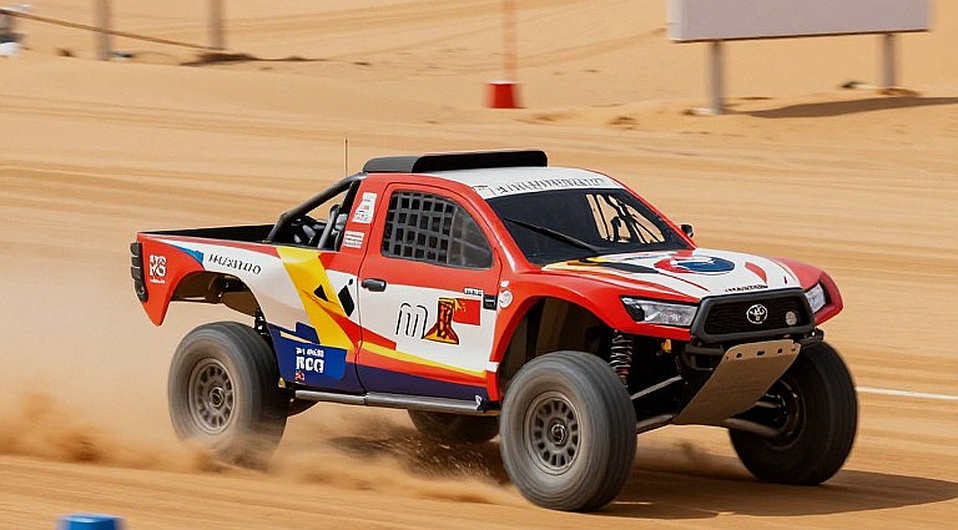
Max Verstappen put it in one word — the car is 'slippery as hell'. Isack Hadjar added that 'everything is going to be on fire'. Before a single lap of Friday practice, both remarks sound like weather complaints. To me they are the first public signal of a specific hole in the 2026 regulations, one that no wind tunnel can reproduce.
The old arithmetic explains why. Mexico was always hard, but teams had two relief valves. The first was wing trim — chasing downforce back in thin air by going to something close to a Monaco-spec wing. The second was the MGU-H, electrically pre-spooling the turbo to hide the lag, which at altitude was the most useful tool in the box.
Both relief valves were removed at once for 2026. The MGU-H is gone from the regulations, and active aerodynamics has collapsed the trim window to effectively one specification — in Verstappen's words, you now basically just run one wing. This is not a set-up preference; it is a rules-design artefact. Both traditional altitude remedies were closed off in the same season.
I left a print desk for a garage floor and a faster clock, and ever since, a circuit's altitude has read to me like its most honest biography. Mexico's biography this year says three things are colliding — reduced downforce, turbo lag, and heat.
The first consequence is direct. To make the same absolute intake pressure in thin air, the turbo has to spin faster. The MGU-H used to govern spool electrically; that job now falls entirely to exhaust gas, which means the compressor may have to run closer to its mechanical limit. That is a reliability exposure, and one no driver can cover with skill. Verstappen said as much — there is little the drivers can do. He also dismissed the trick of holding lower gears to keep the revs up, and that is technically significant. This is a compressor and spool problem, not a gearing problem, and the whole burden sits with the power unit engineers.
The second consequence is thermal rather than lap-time. Thin air reduces the mass flow reaching radiators, brake ducts and the engine bay. Hadjar's 'everything on fire' is rhetorical but directionally right. Expect teams to run maximum cooling louvres and exits. That costs drag, but at altitude drag is cheap — the downforce is already gone, so giving away a little more hurts less. If anyone's Sunday is dictated by brake or power unit temperatures rather than tyre life, that is a far more serious constraint.
The third consequence rewrites the performance order. When downforce falls and lag rises, the difference shows up in the slow stuff — traction out of the stadium section, mechanical grip and suspension compliance on a low-grip surface, and braking stability. Verstappen himself flagged the shift in emphasis. At altitude, power unit driveability is worth more than an aerodynamic advantage.
Then there is the new surface. Fresh asphalt offers more grip on paper, clawing back some of the altitude loss. But new surfaces never behave linearly — bitumen leaches, grip evolves fast from FP1 to FP3, and any team that locks its set-up on Friday evening regrets it on Saturday. All of which means the real work happens overnight, re-running the simulation.
For Red Bull Ford this week is a genuine unknown unknown. It is their first season, and this is their first real altitude operation. Mercedes, Ferrari and Honda carry years of altitude data to calibrate compressor maps, charge-air cooling and turbo speed limits against. A new manufacturer does not have that book. Red Bull Ford's real test in Mexico is not grid position; it is calibration hygiene.
Which makes Verstappen's framing worth reading closely. He said the RB22 does not really excel in low-speed corners. Yet in the same breath he has a Singapore win and a Monaco front row — both low-speed circuits, and the Monaco result came before major upgrades. I have watched this pattern in Thursday press conferences for two decades. When a driver foregrounds precisely the weakness that will matter most on Sunday, he is not filing an engineering report. He is lowering the ceiling of expectation.
The outside world will read this weekend one way; the inside will read it another. The easy paddock conclusion is that Red Bull is in trouble. Mine is different: this is a calibration weekend, not a competitiveness verdict. Altitude is the single most de-correlating variable of the 2026 season — it cannot be built in a wind tunnel or on a dyno calibrated at sea level. Whatever happens on Sunday should carry very little weight in any season-long judgement.
That is why George Russell's comment carries the most competitive freight. He suggested Ferrari's smaller turbo could give it an altitude edge. As engineering it is a legitimate hypothesis — lower rotating inertia means faster spool, which means less lag out of slow corners. But it was said publicly, by a rival, at the one circuit where lag matters most. It could be genuine technical respect, or deliberate expectation-shifting onto Ferrari. The reporting does not resolve it, and neither will I.
There is a corollary that gets lost. A lower-inertia turbo usually accepts a compromise in peak compressor flow — a top-end power ceiling. If Russell is right about Ferrari's altitude benefit, the logical implication is that Ferrari is giving something away on the straights elsewhere. Mexico may flatter Ferrari relative to its true season-level competitiveness.
Hadjar's position is the mirror image. His framing — that he is not thinking about Ferrari or Mercedes, and why not here? — is a rational risk-off statement. For a team whose power unit has no altitude history, reframing an unknown as an opportunity protects it from a narrative of technical vulnerability. But the weekend's real value to him is not the result. A sophomore driver, an unfamiliar low-grip surface, a reduced downforce package — that is the most dangerous recipe for overdriving. For Hadjar this weekend is diagnostic: reaching Sunday evening without a heavy crash is itself a performance metric.
In 2026 I spent eleven days outside the Silverstone factory gates while the arithmetic slowly turned into a farewell, and I learned there that a team's real pulse is heard on the shop floor, not in a press conference. This weekend that pulse is in a dyno cell in Milton Keynes, where a calibration engineer is sitting with a sea-level map and rewriting it for 2,286 metres. Every hour from Tuesday morning to Friday night has gone into work no camera will show. Every beat has a pulse; stand close enough and you can hear it.
On Sunday night the question will not be who won. It will be whether we learned anything from the result — or mistook one thin-air weekend for the new truth of a championship.